I believe that we live in a society where democracy is challenged, where elitists are under the surface of society, secretly governing us. In my opinion, I think that citizen journalism is an Important form of journalism. For important issues it’s good to have lots of different opinions. From a journalistic point of view, having varied opinions, being a part of the same conversation is valuable. It’s not just mainstream media presenting its view, it’s important to have alternative views, it gives people as they are consuming the news to form their own opinions and their thoughts on anything. Citizen journalism is valuable; however, it needs to be taken in the context that it’s a citizen and not a professional. Due to its personal constructed view, if one is debating public policy, health, and important issues, then I believe it just needs to carefully be communicated, and viewers need to be aware when viewing that this is the opinion of a non-qualified journalist. In any form of journalism or media, the biggest challenge that media faces are integrity and accuracy. Agenda is an important factor that viewers need to also be subconsciously aware of. Citizens who report about social issue or politics, usually have an agenda, which is also why many criticise mainstream media, that it’s very left or right or just presenting the westernised view of the world. The challenges that are faced around citizen journalism is that of agenda and accuracy. I believe there is a fine line between expressive and alternative view.
In this article I will analyse Egypt’s journalistic view and review its outlook on the practice of Citizen Journalism within the country. Today, it is almost impossible to think of a world without new media. Citizen journalism and the Egyptian revolution is a common topic, that is very much discussed.
Changes in the Egyptian media has progressed in a very short period. The ownership of Egypt’s mainstream media is very much owned and directed by current governing members of the ‘National Democratic Party’ (NDP). Dr Hussein Ami, Report on the State of the Media in Egypt: Second
“The Egyptian government owns controlling shares in the three main daily newspapers in Egypt, Al Ahram, Al Akhbar and Al Gomhuriya. The editors-in-chief of these dailies are appointed by the President through the Higher Press Council which is headed by the Shura Council Speaker, and the employees are chosen from the members of the ruling National Democratic Party (NDP) through the parliamentary advisory body, the Shura Council (Hafez 1993)”.
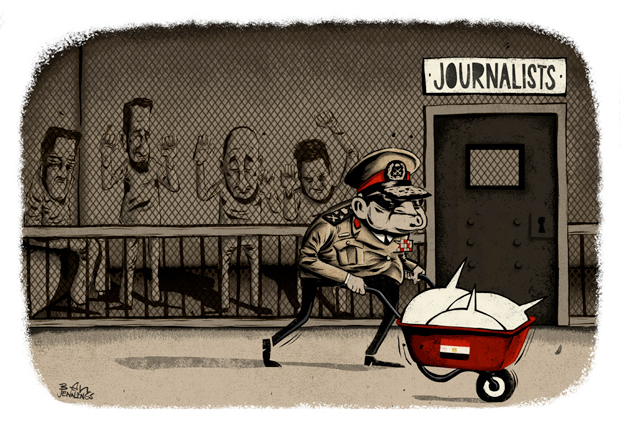
The margin of freedom allowed for the media wavered between press freedom and government repression. Government regulations towards media are clearly present. Oppositional voices such as the citizens of Egypt, have created their own platforms to express their critical thoughts and oppositional views. The Internet is rapidly growing in Egypt, it allows for an in and outflow of information, new media enables a form of citizen journalism. Prior to 1990, most media ownership in the Arab world lay largely with governments, and most media functioned under strict government supervision/control. Arab media is mostly controlled by governments mainly to keep their grip on people and thus making it incapable for citizens to effectively participate in political controversies or rational debates.
Political blogging is a common form of citizen journalism that is practiced in Egypt. Teresa Pepe, Blogging from Egypt: Digital Literature, 2005-2016 (Edinburgh: Edinburgh University Press, 2019) – Teresa Pepe states:
“Blogging had emerged in 2004 mostly as a tool for political activity, to coordinate the activities of the newly emerged (Kifaya) grassroots movement. For this reason, academic research had primarily focused on blogging using a political and public sphere perspective, often leaving behind what was actually written on these blogs”.
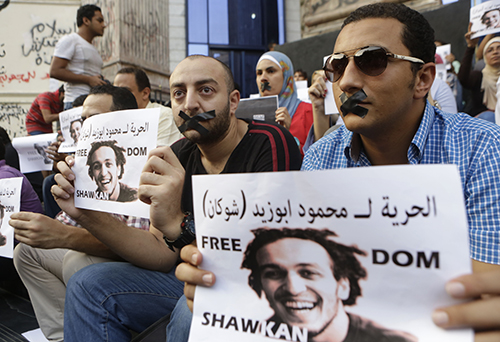
In countries like Egypt, I believe the concept of citizen journalism is extremely dangerous, but also crucial. Media that is run by the government is an oppressive scheme. I believe that if a government implements strict regulations and enforces strict laws that govern media usage, publishing, and journalism, it forms the question: “What have they got to hide?”. Freedom of expression is important and a civil right to all individuals, media platforms present a gateway for citizens to express their views. It is up to the individual to take responsibility in reporting truthfully and with integrity, and understand, especially in suppressive system of government countries, the consequences may be dangerous.
BIBLIOGRAPHY
Amin, H., 2007. Media Laws in Egypt. [ebook] p.6. Available at: <https://www.arabruleoflaw.org/Files/PDF/Media/English/P2/Egypt_MediaReportP2_En.pdf> [Accessed 27 August 2021] – “The Egyptian government owns controlling shares in the three main daily newspapers in Egypt, Al Ahram, Al Akhbar and Al Gomhuriya. The editors-in-chief of these dailies are appointed by the President through the Higher Press Council which is headed by the Shura Council Speaker, and the employees are chosen from the members of the ruling National Democratic Party (NDP) through the parliamentary advisory body, the Shura Council (Hafez 1993)”.
Political blogging is a common form of citizen journalism that is practiced in Egypt. Teresa Pepe, Blogging from Egypt: Digital Literature, 2005-2016 (Edinburgh: Edinburgh University Press, 2019) – Teresa Pepe states: –“Blogging had emerged in 2004 mostly as a tool for political activity, to coordinate the activities of the newly emerged (Kifaya) grassroots movement. For this reason, academic research had primarily focused on blogging using a political and public sphere perspective, often leaving behind what was actually written on these blogs”.
Monitor, T., 2021. Egypt’s growing blogger community pushes limit of dissent. [online] The Christian Science Monitor. Available at: <https://www.csmonitor.com/2005/0824/p07s01-wome.html> [Accessed 30 August 2021].
(www.dw.com), D., 2021. Egypt: The Bloggers and the Revolution | DW | 12.11.2012. [online] DW.COM. Available at: <https://www.dw.com/en/egypt-the-bloggers-and-the-revolution/a-6470670> [Accessed 30 August 2021].


Leave a Reply